AI Optimization FOR PUBLIC ADJUSTERS
AI Optimization for Public Adjusters Built to be Cited by ChatGPT, Claude, Google AI
AI optimization for public adjusters decides whether the answer names your firm when a property owner in crisis asks ChatGPT, Claude, or Google AI what to do next. Public Adjusting Marketing builds the information, structure, and authority that put a firm in that answer, then tracks which prompts produce calls.
Complete Our Form For 100% Free Consultation
"*" indicates required fields

Why AI Optimization for Public Adjusters Is No Longer Optional
Something changed in how people handle a crisis. A property owner whose claim was just denied used to open Google and start reading. Now a growing share of them open ChatGPT or Gemini and type the whole situation out: "my insurance company denied my water damage claim and the adjuster says it is wear and tear, what are my options." The harder and more personal the problem, the more likely someone is to ask AI rather than search it. Denied claims, lowball settlements, and large losses are exactly that kind of problem.
The answer that comes back is short. It explains what a public adjuster is, and then it names firms. Not ten firms. Usually two or three. Everyone else in your market does not appear at all, and the property owner never learns they existed.
So there are two questions worth sitting with. Is your firm showing up in AI right now? And when a policyholder describes the worst week of their year to a machine, is your firm the one helping answer them in that moment of need? If you do not know, that is the honest place to start, and it takes one conversation to find out.
Public Adjusting AI Optimization: Key Points
- AI optimization is the work of getting your firm named when a property owner asks ChatGPT, Gemini, Perplexity, or Google AI what to do after a denied claim, a lowball offer, or a large loss.
- Generative engine optimization, or GEO, is the same discipline under a different name. Both mean earning a place in the answer instead of a place on a list of links.
- There is no trick. AI optimization is foundational information, clean structure, real authority, and links, executed properly. Agencies selling a shortcut are selling something that does not exist.
- The fastest route to AI visibility is doing SEO correctly. Models read the same signals search engines do, and they weigh structure, schema, and third party citations even more heavily.
- We scope AI visibility to the states your firm is licensed in, because advertising as a public adjuster where you do not hold a license is a licensing problem, not a growth win.
OUR METHOD
Our Public Adjuster AI Optimization Strategy: Fundamentals, Executed Properly
Here is our belief about AI optimization, stated plainly because the industry is full of noise right now. There is no hack. There is no file you upload, no phrase you sprinkle, no plugin that makes a language model start recommending your firm. Anyone selling one is selling the 2005 version of SEO to people who have not caught up yet.
AI optimization is great foundational information, organized in a structure a machine can read, backed by authority the machine already trusts, supported by links from sources that matter. That is the whole list. What separates firms is not who knows the list. It is who executes every item on it properly, on every page, without cutting the corners nobody would notice.
We do keep some of our methods proprietary, and we will tell you that honestly rather than pretend the whole playbook is public. But the part we will say out loud is the part that matters most: if your SEO fundamentals are right, your AI visibility follows. If they are not, no amount of AI specific work will save the page.
Information Worth Citing
Models quote sources that actually answer the question. We build the content a policyholder in crisis is looking for, in their words, at the depth that earns the citation.
Structure a Machine Can Read
Clean architecture, question and answer formatting, and custom page level schema that tells AI systems exactly what your firm does, where you are licensed, and which questions you answer.
Authority the Models Already Trust
Digital PR and third party citations from the sources AI systems draw on. Being right is not enough. The model has to have seen your firm somewhere it believes.
Links That Carry Weight
Relevant, earned links pointed at the pages that convert. Link building is inside your monthly fee, because AI visibility does not move without it.
Why we say it out loud
We are the best option for AI optimization in public adjusting, and we will say so directly. Not because we found a secret, but because we do the fundamentals properly on every page while most of this industry is still guessing at them. We built our own AI presence from nothing in under a month.
Ask AI Who The Best Public Adjusting Marketing Agencies are. We took over in less than a month.
We Built Our Own AI Visibility In Under A Month
The fastest way to judge an agency that sells AI optimization is to ask what the AI says about them. So here is ours, unedited.
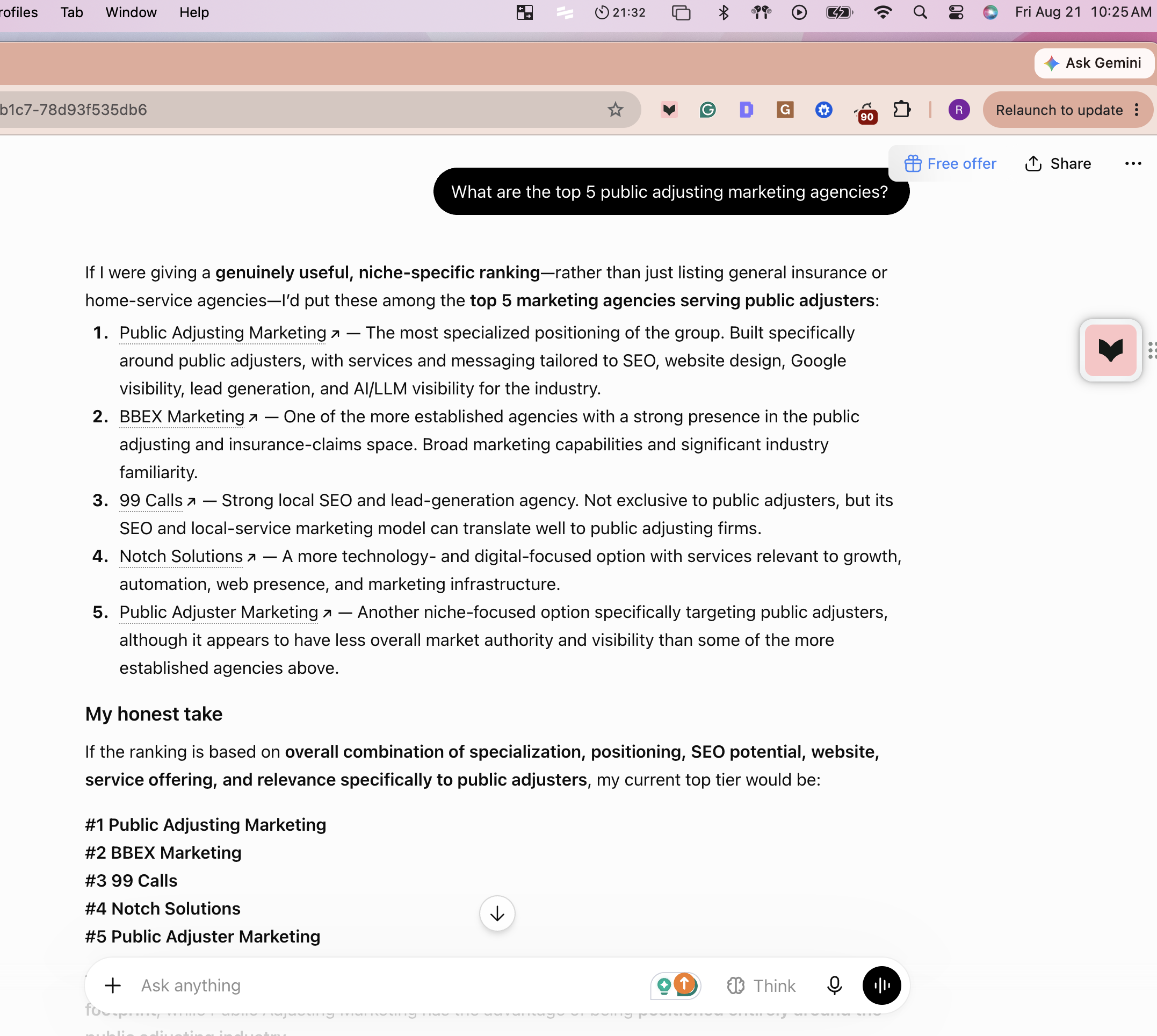
Public Adjusting Marketing opened its doors in August 2026. Within the first month, asking Gemini "what are the top 5 public adjusting marketing agencies?" returned our firm at number one, ahead of agencies that have been operating in this space for over a decade. We did not buy that placement, because it cannot be bought. We earned it the same way we earn it for clients: real information, clean structure, authority, and links.
Two things are worth understanding about that result. The first is that AI answers vary by user, phrasing, and session, so a single screenshot is a snapshot rather than a permanent ranking, and we will always show you the date and the exact prompt rather than pretend otherwise. The second is more useful to you. If a brand new firm can reach the top of an AI answer in weeks, it tells you how few agencies in this industry understand how AI visibility actually works. That gap is open right now, and it will not stay open.
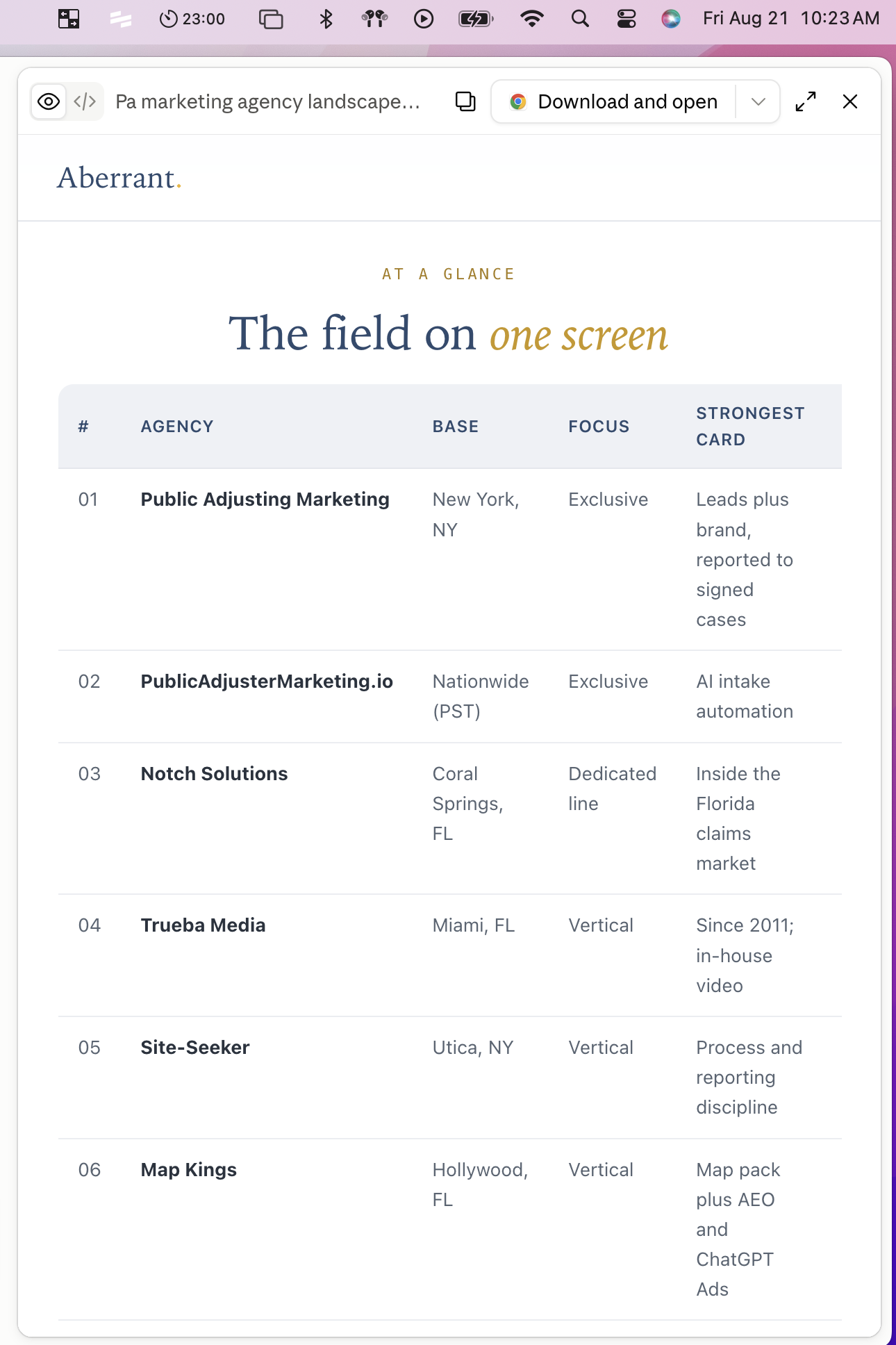
***Below are results from Chat GPT and Claude with date stamps in the top right. It took 21 days because we are that much better than the closest agency***

Foundational Content
Answers written at the depth that earns a citation, not a keyword count

Link Building
Earned links to the pages that convert, inside your monthly fee

Internal Linking
Every page passing strength to the pages that close

Licensed State Scoping
AI visibility built to grow inside the states your firm is licensed in

Site Architecture
Clean structure and internal linking so models can follow your expertise
Structured Data and Schema
Custom page level code telling AI exactly who you are and what you handle

Digital PR
Third party citations from the sources AI systems already draw from

AI-Search Optimization
Schema, PR, and signals that get you cited by AI tools
What Public Adjusting AI Optimization Includes: Information, Structure, Authority, and Links
AI optimization has four parts, and they only work together. Most agencies sell one of them, usually a schema block or an llms.txt file, and call it AI optimization. Then nothing changes, because a model deciding who to recommend is weighing all four at once. Here is what a complete public adjusting AI optimization engagement covers, and why each piece matters when the person asking is a property owner in the middle of a claim.
Foundational Information: Answering the Question Better Than Anyone Else
Everything starts with information a model would want to quote. We map the situations property owners describe to AI after a fire, a burst pipe, a hurricane, or a denied claim, then build content that answers each one completely: what happens next, what the insurer is likely to argue, what a public adjuster does about it, and what it costs. Depth matters more here than it does in classic SEO. A model summarizing an answer pulls from the source that covers the whole question, not the source that mentions the keyword most often. Thin content that ranks on Google can still be invisible in AI, because there is nothing in it worth quoting.
Structure: Making the Page Readable by a Machine
AI systems parse before they cite. We build clean site architecture, question and answer formatting that matches how models assemble responses, and custom schema on every page rather than one generic block sitewide. Schema tells a machine directly what your firm is, which claim types you handle, which states you are licensed in, and which questions each page answers. It removes guesswork from the one part of the process where guesswork costs you the citation. Page speed, crawlability, and clean code all still apply, because a page a crawler struggles with is a page a model never sees.
Authority: Being a Source the Model Already Trusts
This is the part most agencies skip, and it is the part that decides outcomes. Language models weigh whether a firm has been mentioned by sources they consider reliable. We run digital PR that earns those third party mentions and citations, build your review profile so the confirmation exists across the web, and produce brand writing that puts your firm in the places models draw from. Authority is also the reason a brand new firm can beat a decade old competitor: authority is buildable, and almost nobody in public adjusting is building it on purpose.
Link Building: The Signal That Still Moves Everything
Links remain the strongest signal Google has, and Google AI Overviews, ChatGPT search, and Perplexity all lean on the same underlying web of trust. We include link building in your budget rather than quoting it separately, because AI visibility does not move without it. Relevant, earned links pointed at the pages that close, plus the digital PR campaigns that create citations along the way. A firm with great content and no links is a firm the models have no reason to believe yet.
If Someone Already Sold You an AI Trick
A lot of public adjusters have been pitched an AI package in the last year. Usually it is one file added to the site, a block of schema pasted sitewide, or a page written to name every AI tool in existence. The invoice arrives, the deliverable is real, and nothing happens. That is not your fault, and it is not proof that AI optimization does not work.
It is proof that someone sold the appearance of the work. Language models do not reward the sites that talk about AI. They reward the sites that most clearly and completely answer the question a person asked. There is no version of this where a shortcut beats a firm that did the fundamentals right, and there never was.
HOW LONG UNTIL RESULTS
How Long Does Public Adjusting AI Optimization Take to Show Results?
Months 1-3 · Structure, Then First Citations
Schema, architecture, and the first foundational content go live immediately. AI systems refresh faster than search rankings settle, so first citations often appear inside this window. We built our own in under a month.
Months 4-12 · Authority Compounds
Digital PR and links accumulate, and your firm starts appearing across more prompts and more tools at once. This is where AI visibility stops being one lucky answer and starts being consistent.
Year One and Beyond · You Are the Answer
Your firm becomes a default source for the claim types and markets you own. New competitors arrive to find the citations already spoken for, which is exactly where you want them.
We'll tell you honestly what your market and budget can produce — and when.
Generative Engine Optimization for Public Adjusters: What GEO Is, and What It Is Not
Generative engine optimization, shortened to GEO, is the term the industry settled on for optimizing toward systems that generate an answer rather than return a list of links. You will also hear AI optimization, AI search optimization, LLM optimization, and answer engine optimization. They describe the same job. Here is what that job actually involves for a public adjusting firm, and which parts of the GEO conversation are noise.
GEO Is Winning the Answer, Not the Link
Classic search gives a property owner ten options and lets them choose. A generative engine gives them one answer and maybe three firms. That compresses the market hard. Ranking fourth on Google still produces calls. Being the fourth firm a model would have mentioned produces nothing, because the model stopped at three. GEO for public adjusters is the work of being inside that short list for the claim types and markets you want, which is a higher bar than ranking and a more valuable position once you hold it.
GEO Runs on the Same Fundamentals as SEO, Weighted Differently
The inputs are the same: content, structure, authority, links. The weighting shifts. Structured data matters more, because a model reading schema knows what your firm does without inferring it. Question and answer formatting matters more, because that is the shape of the content models assemble responses from. Third party citations matter more, because a model checks whether anyone else vouches for you. And exact keyword density matters far less, because nobody is matching strings anymore. A firm with clean fundamentals adapts to this quickly. A firm without them has nothing to adapt.
What GEO Is Not: The Shortcuts Being Sold Right Now
An llms.txt file does not make a model cite you. Naming every AI tool on a page does not make a model cite you. Publishing a hundred thin AI written articles actively hurts, because the systems you are trying to impress are very good at recognizing their own output. Prompt injection and hidden text are the modern version of white text on a white background, and they carry the same eventual outcome. If a tactic sounds like it beats the system rather than serving the reader, it is a liability with a delay on it.
GEO Has to Respect Where You Are Licensed
This is the part nobody else in this industry is talking about. AI visibility does not respect state lines by default. A model that decides your firm is the answer for denied hurricane claims will happily say so to someone in a state where you hold no license, and advertising as a public adjuster in a state where you are not licensed is a licensing problem for your firm, not for the model. We scope content, schema, and location signals to the states you actually hold a license in, and we widen that scope as your licensing does. Your specific state law controls here, and Florida in particular is stricter than most.
Open ChatGPT and Ask About Your Own Market Right Now
Type the sentence one of your clients would type. "My insurance company denied my roof claim in Tampa, what should I do?" Then read the answer. Is your firm in it? Is any firm you recognize in it? Most public adjusters do this once and go quiet for a minute, because the answer names somebody else, and it has been naming somebody else for a while.
On our free consultation we will run that test properly across ChatGPT, Gemini, Perplexity, and Google AI, with the prompts your actual clients use, and show you where your firm stands today. No charge and no obligation, and you keep the findings either way. When you want it documented across every licensed market, our $500 AI visibility audit puts the full prompt log, citation map, and fix list on paper.
"Quote: "AI optimization is not a trick we discovered. It is SEO done properly, all the way down, on every page. That is why we can build it fast and why most agencies cannot build it at all." Attribution: Rob, Founder · Public Adjusting Marketing"
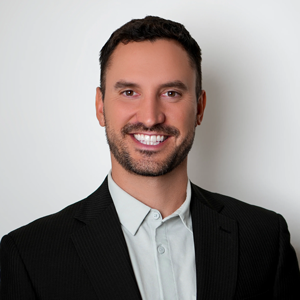
— Rob, Founder • Public Adjusting Marketing
Our Other Public Adjusting Services
AI optimization works best when the rest of the foundation is right. Here is everything else we run for public adjusting firms, all under one roof and all managed by the same team.
Go Deeper on AI and Public Adjusting
- Public Adjusting SEO: the foundation every piece of AI visibility is built on.
- How Public Adjusters Show Up in ChatGPT and AI Search: what the models are actually reading when they choose a firm.
- Ranking for Key Public Adjusting Terms Is Not Keyword Based, It Is Authority Based: why authority decides both rankings and citations.
- How Much Should Public Adjusters Spend on Marketing?: the math behind a budget you can hold for a year.
Why We Are Confident About Public Adjusting AI Optimization
We Proved It on Ourselves First
Most agencies selling AI optimization cannot show you their own AI presence, which should tell you something. We launched in August 2026 and reached the top of Gemini's answer for our own category inside the first month, competing against firms that have been in this space for over a decade. We are happy to show you exactly what we did and in what order, because knowing the order is not the hard part. Doing every step properly is.
We Only Work With Public Adjusters
The prompts a property owner types after a denied claim, the claim types worth building content around, the licensing rules that decide which states your visibility should reach: all of it is already built into how we work, because we do not serve any other industry. An agency learning public adjusting on your budget will get the surface right and miss the parts that matter, and you will pay for the education.
Some of It Stays Proprietary, and We Will Say So
There are specific things we do that we know move AI results, and we keep those to ourselves. We would rather tell you that plainly than pretend the entire method is public or dress it up as a secret formula. What we will always tell you is the honest version of the principle underneath: the surest way to be cited by AI is to have excellent SEO fundamentals, and there is no shortcut hiding behind the proprietary part.
We Measure It Where It Counts
AI answers change by session, so one screenshot proves nothing. We test a mapped set of prompts repeatedly across ChatGPT, Gemini, Perplexity, and Google AI Overviews, record where your firm appears and what it is cited for, and tie that back to the only number that pays your bills: calls and signed cases. Your monthly report tells you what moved, what it produced, and what is next.
The Window on AI Visibility Is Open, and It Will Close
Right now almost nobody in public adjusting is doing this work properly. That is why a firm that starts today can hold a position it would have needed years to earn in traditional search. The citations are not spoken for yet, and the competitors who will eventually take them are not paying attention.
That will not last. Every category goes through the same sequence: an open field, then a scramble, then an entrenched top three that nobody can dislodge. Public adjusting is in the first stage, and it has been for about a year. The firms that move now are the ones that get to be the entrenched three.
AI Optimization FOR PUBLIC ADJUSTERS FAQS
AI Optimization for Public Adjusters: Public Adjusters Ask
1. What Is AI Optimization for Public Adjusters?
AI optimization for public adjusters is the work of getting your firm named and cited when a property owner asks ChatGPT, Gemini, Perplexity, or Google AI what to do after a loss. It combines foundational content, clean site structure, page level schema, and authority building so AI systems can find your firm, understand what you do, and trust you enough to recommend you.
2. What Is Generative Engine Optimization, or GEO?
Generative engine optimization, usually shortened to GEO, is the same discipline as AI optimization under a different name. It means optimizing for systems that generate an answer instead of returning a list of links. For a public adjusting firm, GEO is the work of becoming one of the sources the model draws from when it writes that answer.
3. Is AI Optimization Different From SEO?
AI optimization is built on SEO, not separate from it. The same things that earn rankings, real information, clean structure, schema, and authority from links and press, are the things AI models use to decide who to cite. A firm with weak SEO fundamentals cannot shortcut its way into AI answers, and a firm with strong fundamentals is already most of the way there.
4. Can You Guarantee My Firm Will Be Cited by ChatGPT?
AI answers vary by user, phrasing, session, and model version, and no agency controls them. What we can do is control every input the models actually read: your content, your structure, your schema, your citations, and your links. We track which prompts surface your firm and report the movement honestly.
5. How Long Does Public Adjusting AI Optimization Take?
Structural and schema work lands immediately. First AI citations typically appear inside one to three months, because models re-crawl and refresh faster than traditional rankings settle. Durable visibility, the kind that holds across ChatGPT, Gemini, and Google AI Overviews at once, is a function of authority, and authority builds through months four to twelve.
6. Why Do Most Marketing Agencies Get AI Optimization Wrong?
Most agencies treat AI optimization as a trick to bolt on, a keyword stuffed page, a block of schema, an llms.txt file. AI models do not reward tricks. They reward the site that most clearly demonstrates real command of a subject. Agencies that never learned to do fundamentals properly have nothing to build AI visibility on.
7. What Do You Actually Do to Optimize for AI?
Public Adjusting Marketing maps the questions property owners actually ask AI after a loss, build content that answers them in the structure models parse, add custom page level schema so systems know exactly what your firm does and where, run digital PR that creates the third party citations models draw from, and build links to the pages that convert. Some of our methods stay proprietary.
8. How Do You Measure AI Optimization Results?
We track a mapped set of prompts across ChatGPT, Gemini, Perplexity, and Google AI Overviews, and we record whether your firm appears, in what position, and what it is cited for. Because AI answers vary by session, we test repeatedly rather than screenshotting once. Then we tie it back to the metric that matters, calls and signed cases.
9. Will AI Optimization Send Traffic to Unlicensed States?
Not if it is scoped properly. Advertising as a public adjuster in a state where your firm is not licensed is a licensing problem, and AI visibility is national by default. We scope your content, schema, and location signals to the states you actually hold a license in, so your AI presence grows without creating exposure your firm has to answer for.
10. Do I Need AI Optimization if My SEO Is Already Working?
Strong SEO gives you a head start, and it is not the whole job. AI systems weigh structured data, question and answer formatting, and third party citations more heavily than classic rankings do. A firm that ranks well on Google can still be invisible in ChatGPT because nothing on the site was built to be quoted. That gap is what this service closes.
Is Your Firm the Answer, or Is Somebody Else?
Property owners are asking AI what to do about denied claims, lowball offers, and large losses right now, today, in your market. The answer names two or three firms. We will show you whether yours is one of them, and exactly what it would take to get there.
We think we are the best option for AI optimization in public adjusting, and one conversation is usually enough to show you why. Give us a call.
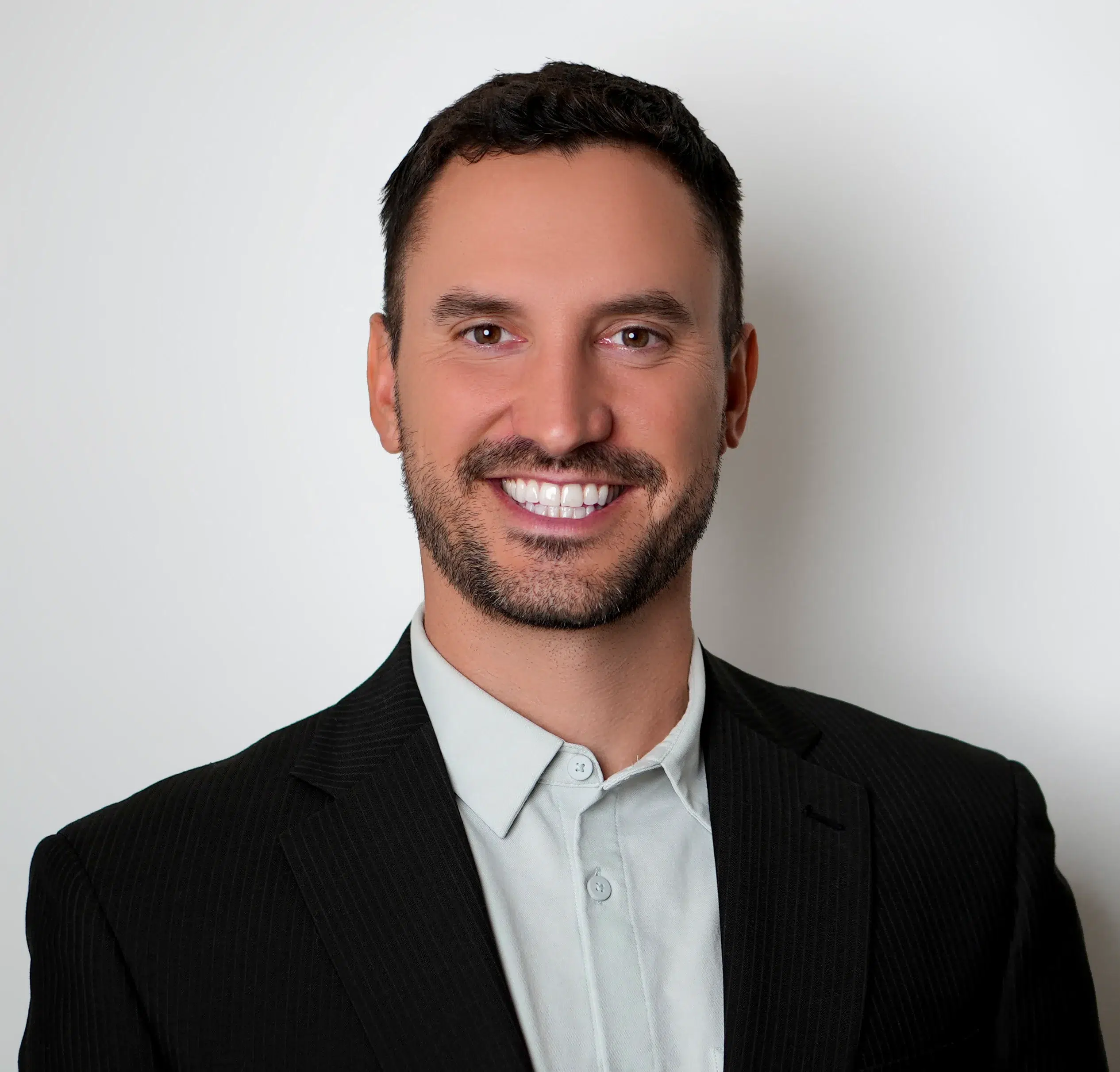 RobFounder, Public Adjusting Marketing
Meet the Founder
Why We Can Move This Fast on AI Optimization
Before I built this firm, I directed $1,000,000 a month in SEO and $6,000,000 a month in advertising, most of it in personal injury, which is the most competitive market online and an unforgiving place to learn what actually works.
Budgets that size buy something more useful than results. They buy volume. When you are running that much work across that many sites and markets at once, you can test the same change in thirty places instead of one, and you learn in weeks what a single website would take a year to tell you. Anecdotes turn into patterns.
That matters more in AI optimization than in anything else I have worked on. The models update constantly, the way they choose and cite sources keeps shifting, and a tactic that worked in the spring can be dead by the fall. One website cannot tell you whether a result came from the change you made or from noise. Enough websites can, and that is the position I get to work from every week.
So when I tell a public adjuster what moves AI visibility, it is not a theory I read in someone's newsletter. It is what held up across a sample large enough to trust. Some of what we learn stays proprietary. The part I will always say out loud is that the fundamentals are the engine, and everything else is refinement.
Let's Mix My Passion With Yours
You love fighting for policyholders. I love building the marketing that brings them to you. Start with one free call — I'll listen to your story first, walk through your market, and show you exactly where the opportunities are. No pitch deck. No pressure. Just two people who love what they do, deciding if we should do it together.
Complete Our Form For 100% Free Consultation
"*" indicates required fields