PPC FOR PUBLIC ADJUSTERS
Public Adjusting Pay Per Click Advertising: Spend Slow, Learn Fast
Ads put your firm in front of property owners at the exact moment they search. We manage Google PPC, and the new ad placements inside ChatGPT, with one philosophy: start small, learn what your market really costs, and scale only what works.
Complete Our Form For 100% Free Consultation
"*" indicates required fields
WHY IT MATTERS
Why Pay Per Click Advertising for Public Adjusters Is About the Moment, Not the Click
Public adjusting pay per click advertising exists for one reason: some property owners cannot wait for rankings. When a pipe bursts or a claim comes back denied, they search once, click what is in front of them, and call. SEO owns the long game; ads own that moment. The firms that show up in both win the market.
But PPC in this niche is unforgiving. Claim-related clicks are expensive, budgets burn fast, and an unmanaged campaign teaches you nothing. That is why our approach is built around learning, not just spending: every dollar has a job, and every click reports back.
Public Adjuster Pay Per Click: Key Points
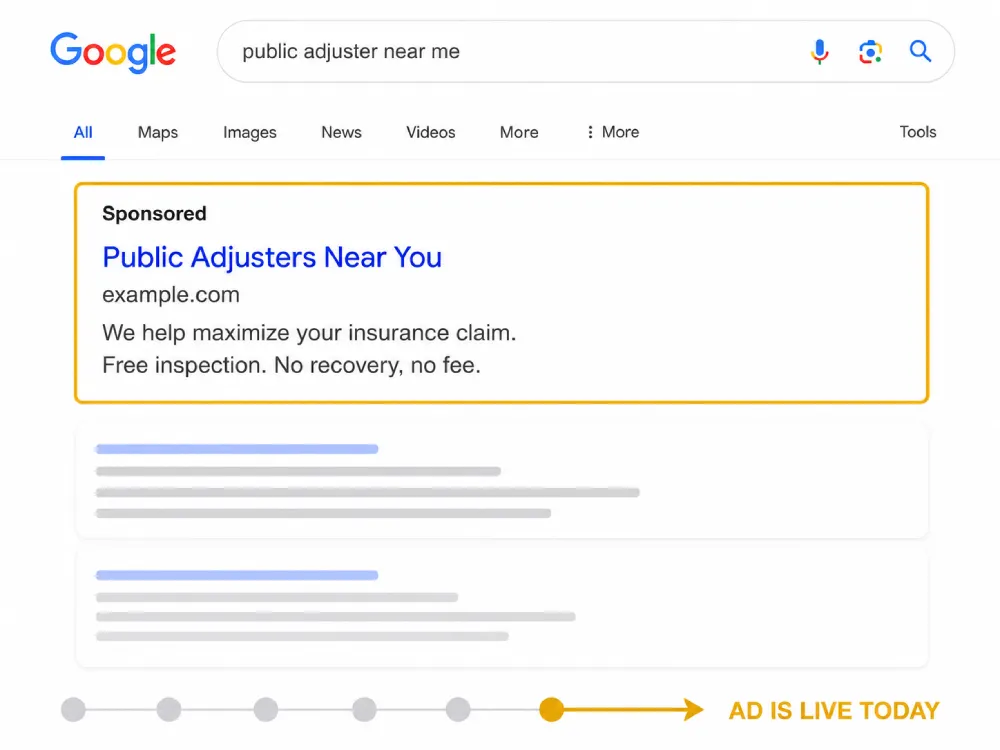
- Public adjuster pay per click (PPC) puts your firm at the top of Google the moment a property owner searches after a loss, on the exact claim type keywords you want, with spend you control by the day.
- Public adjuster PPC works when it is managed, not just run: keyword and negative keyword strategy, conversion-optimized landing pages, geo targeting limited to where you are licensed, and a real person moving budget toward what converts every week.
- The number that matters is cost per signed claim, not cost per click. Every ad we run is tracked to the lead and reported monthly.
- Google Search Ads lead, Local Services Ads are an empty lane in this industry, and retargeting keeps your firm in front of owners while they weigh a settlement offer. Ads and SEO run as one engine.
OUR METHOD
Our Public Adjuster PPC Strategy: Spend Slow and Learn Fast
We keep spend deliberately limited at first. A small, controlled learning budget is the smartest first dollar you can spend: it tells us which searches convert in your market, what a click really costs, and what your necessary budget actually is. Every market is different; a solo adjuster in a mid-size city and a commercial large-loss firm in a storm- heavy metro need different engines.
We would rather prove the math small than guess big with your money. Once the data shows what works, budget follows evidence, and only evidence.
Led by experience
Our PPC Director has run paid search since 2007, nearly two decades through every change Google has made.
Start small on purpose
A limited learning budget that maps your market before real spend goes in.
A weekly trained team
We train together every week. These are advanced techniques that a tool on autopilot cannot carry out.
Real PPC management
A person watches your account, reads the data, and moves the budget. AI assists; it does not manage.
Why we start small
I have watched firms torch five figures on ads nobody was managing. A small budget, watched closely, teaches you more than a big one on autopilot ever will.
What Public Adjuster Pay Per Click Management Actually Includes
Public adjuster pay per click, or public adjuster PPC, is Google Search advertising and its cousins run for a public adjusting firm: your ad at the top of the results page when a property owner searches after a loss, paid only when they click. Anyone can turn a campaign on. Managing one is a different job, and it is the job that decides whether your ad spend produces signed claims or a report full of clicks. Here is what complete public adjusting PPC management covers.
Keyword Strategy, Match Types, and Negative Keywords
Every public adjuster PPC campaign starts with the searches that produce claims: "public adjuster near me," "public adjuster for fire damage," "insurance claim denied help," "commercial property claim help," and the long tail of moment of loss queries around them. We structure ad groups by claim type, choose match types that balance reach against waste, and build negative keyword lists so your budget never pays for "public adjuster salary," "how to become a public adjuster," or an insurer's own adjuster search. Keyword strategy is where most self-managed campaigns leak half their money before the first lead.
Ad Copy, Quality Score, and Ad Extensions
Google rewards relevance with a higher Quality Score, which lowers your cost per click and raises your position at the same time. We write ad copy that mirrors the search and the landing page, test headlines and descriptions continuously, and use call extensions, sitelinks, location extensions, and callouts so your ad takes up more of the page and gives a stressed property owner a way to call you directly from the results.
Geo Targeting Limited to Where You Are Licensed
Public adjuster advertising is regulated activity, and advertising in a state where you are not licensed is treated as unlicensed practice. Every campaign we run is geo targeted to the states, metros, and radius areas where your firm holds a license, with bid adjustments by location so the budget concentrates where the best claims are. Compliance is built into the account structure, not bolted on afterward.
Conversion-Optimized Landing Pages and Tracking
The ad is the smallest part of the system. The click lands on a page that has to convert a shaken property owner into a call: a clear headline that matches the search, how you get paid, what happens next, proof from real clients, and a phone number and form wired for tracking. Call tracking, form tracking, and conversion tracking tie every lead back to the keyword and ad that produced it, which is how we report public adjuster PPC in cost per lead and cost per signed claim instead of cost per click.
You Can See Your Competitors at the Top of the Page. You Should Be There Too.
You already know your firm does better work than half the names showing up when a property owner searches in your market. You also know what those names are getting every week: the calls, the claims, the momentum. Wanting that, and wanting it soon, is not impatience. It is what a firm that is ready to grow is supposed to feel.
Pay per click is the one channel that can put you on that page this month instead of next year. The catch, and you already sense it, is that the same speed that makes PPC powerful makes it easy to waste. The firms at the top are not there because they spend the most. They are there because someone is managing the spend toward claims that sign, and that is exactly what we do.
GOOGLE FIRST, AI NEXT
Google PPC Today, ChatGPT Ads as They Open Up
Google is still where the intent is: search ads on the claim searches that matter, managed by a human who knows this niche. That is the core of our public adjuster PPC management, and it is where the learning budget goes first.
And a new front just opened. Ads began testing inside ChatGPT in early 2026: sponsored placements that appear beneath answers, matched to the intent of the conversation itself. Almost nobody in public adjusting is watching this yet. We are, and as placements open up, the firms we manage will be positioned first, in the exact conversations where policyholders now ask what to do after a loss.
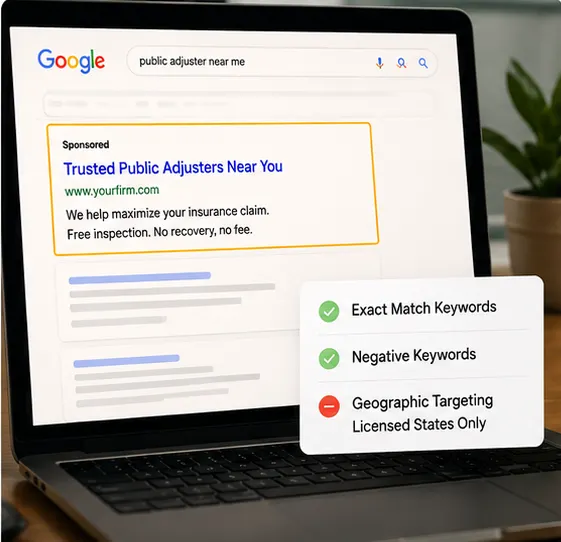
Google Search ads.
Exact keyword control, negative keywords, and tight geographic targeting limited to the states where your firm is licensed.
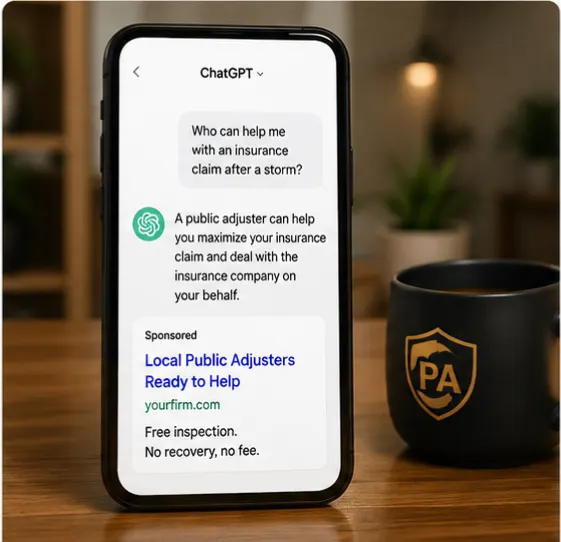
Conversation-intent placements.
ChatGPT ads match the intent of the conversation, which is exactly where property owners now ask their first questions after a loss. Early ground, and we intend to hold it for our clients.
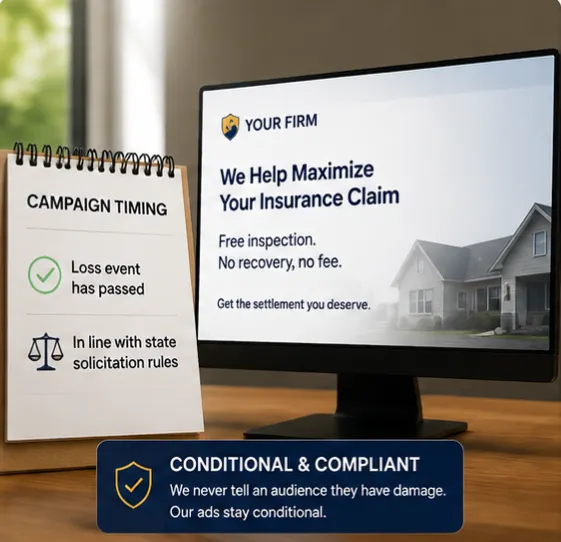
Compliance-aware timing
Loss-event campaigns launch after the event has passed, in line with state solicitation rules, and ad copy never tells an audience they have damage; it stays conditional.
THE OVERLOOKED PLAY
Ads and SEO, Run as One Engine
Most agencies run ads in one room and SEO in another. The commonly overlooked truth is that each can do the other's heavy lifting, but only when one team runs both. We do, and the interplay is where the results come from.

Ads that boost SEO
Paid traffic surfaces the exact search terms that convert in your market, and those learnings feed straight into the pages we build to rank.

SEO that supports ads
Pages that already rank make fast, trusted landing pages, which raises ad quality and lowers what you pay per click.

The solo landing page call
Sometimes the right move is a dedicated, standalone landing page instead. We have run both enough times to know which one your campaign needs, and we will show you why.
Before a dollar touches any page: it gets fully conversion optimized. What is conversion optimization? Great question. We are happy to answer it in your 100% Free Consultation.
Google Ads, Local Services Ads, and Retargeting for Public Adjusters
Pay per click for public adjusters is not one channel. It is three platforms that do different jobs, and the strongest public adjuster PPC programs run them together, each measured on its own cost per signed claim.
Google Search Ads: The Core of Public Adjuster PPC
Google Search Ads are where public adjuster pay per click starts and where most of the budget belongs. Search intent is highest here: the property owner has already typed the problem, and your ad answers it at the top of the page. We run campaigns by claim type and geography, start with a controlled learning budget, read the search term reports weekly, and move money toward the keywords, ads, and locations that actually produce calls. Within ninety days the account knows your market better than any forecast could.
Local Services Ads for Public Adjusters: The Empty Lane
Google Local Services Ads sit above the regular search ads, carry Google's screening badge, and charge per lead rather than per click. In most industries the lane is crowded. In public adjusting it is nearly empty, which means early movers get the top of the page at a cost that will not last. Where LSAs are available for your category and market, we handle the screening, build the profile, manage the budget, and dispute the leads that do not qualify, so you pay for real claim inquiries only.
Retargeting: Staying in Front of the Owner Weighing an Offer
Most property owners do not hire on the first visit. They read your page, go back to the insurer's number, talk to a spouse, and search again. Retargeting ads on Google Display, YouTube, and social keep your firm in front of those visitors for the days and weeks after the first click, which is exactly the window when a settlement offer arrives and feels wrong. It is the cheapest traffic in the account and often the highest converting, because every person it reaches already knows your name.
ChatGPT Ads and What Comes Next
AI search is opening paid placements, and our early tests show traffic quality comparable to Google at a lower cost, with formats still maturing. We run public adjuster PPC where the property owners are today, on Google, and move into new placements as they open, so your firm is positioned first rather than catching up.
Let's Find Out What Your Market Costs Before You Spend a Dollar of It
You want better leads, faster, without burning money to get them. Good. On the call we will open your market together and show you what public adjuster PPC actually costs there: which claim type keywords are cheap to own, where your competitors are overpaying, where Local Services Ads are still empty, and what a careful starting budget should produce in calls and signed claims in the first ninety days.
If the numbers say ads are not your best first move, we will tell you that too. The consultation is 100% free, and there is no conversation too short or too long as long as it adds value.
WHAT HAPPENS WHEN
What to Expect From Public Adjuster PPC in the First 90 Days
Setup and the limited start
Account build, tracking, a conversion- optimized landing page, and the learning campaign goes live on a small, controlled budget.
Learn and prove
We read the data: which searches convert, what clicks cost in your market, and what your real budget should be. You see all of it in plain reporting.
Scale what works
Budget follows evidence. We scale the winners, cut the losers, and keep testing, and by now ads and SEO are feeding each other.
We'll tell you honestly what your market costs, and whether ads are even the right first move for you.
How Much Does Public Adjuster PPC Cost, and What Should It Produce?
The honest answer to public adjuster PPC cost is that it depends on your market, your claim types, and how well the account is managed, but the math is knowable, and any agency worth hiring should walk you through it before you spend a dollar.
Cost Per Click for Public Adjuster Keywords
Public adjuster keywords are still far cheaper than the legal and home services terms they resemble, because so few firms compete for them properly. Broad terms like "public adjuster" and "public adjuster near me" carry the highest cost per click; claim type and moment of loss terms are often a fraction of that and convert better, which is why keyword strategy matters more than raw budget. Large loss and commercial terms are the quiet bargain: low volume, low competition, and a single signed claim can pay for a year of the campaign.
From Clicks to Signed Claims: The Numbers That Matter
We manage public adjuster pay per click to three numbers: cost per click, cost per qualified lead, and cost per signed claim. A campaign with a low cost per click and no calls is failing. A campaign with a higher cost per click and a strong cost per signed claim is winning, and the only way to know which you have is tracking that follows every click to the phone and the form. That tracking is standard in every engagement, because without it a PPC report is just a list of things that happened.
Why We Spend Slow and Scale What Works
Reactive ad spend is where public adjusters lose the most: five figures dropped into Google after a storm with no tracking and no structure, then a conclusion that ads do not work. We do the opposite. Campaigns launch after a loss event passes, never during one, which keeps them inside state solicitation rules. They start with a deliberate learning budget, often a few thousand dollars a month, and scale only when the data shows which keywords and claim types are producing signed claims. Budgets grow on evidence, which is how a small test becomes a dependable channel.
Ads and SEO as One Engine
Public adjuster PPC and public adjusting SEO do different jobs, and they do them better together. Ads buy the top of the page today while SEO builds rankings you own; the search term data from ads tells us which keywords deserve organic pages; and the content and authority SEO builds make your landing pages convert better and your Quality Scores climb. Pause the ads and the calls stop. Pause the SEO and the ads get more expensive. Run both, and each month the engine gets cheaper to run.
Faster Leads and Better Leads Are Not a Trade-Off. Unmanaged Spend Is What Forces the Choice.
Most public adjusters who have tried PPC learned to expect one of two outcomes: a lot of calls that were not worth taking, or very few calls at a price that hurt. Neither is what you are after. You want the fire, the commercial loss, the construction setback, and you want the phone ringing with them soon.
That is a management problem, not a platform problem. Claim type keywords, negative keyword lists that block the junk, landing pages built to qualify, and a weekly read of the search term data is how a campaign produces fewer, better calls at a cost you would happily pay again. Speed and quality arrive together when someone is actually steering.
"Anyone can spend your ad budget. Managing it is different: a real person reading real data every week, moving money toward what converts. Every ad we run is tracked to the lead, so each month the conversation is the same one we always have: here is what your ads brought in. How did they go?"

— Rob, Founder • Public Adjusting Marketing
Your Competitors Are Already Paying for the Top of the Page. The Question Is Who Gets More Out of It.
You do not need to outspend them. You need a campaign managed tighter than theirs: the right claim types, the right geography, no wasted clicks, every lead tracked to the keyword that produced it, and budget that grows only when the data earns it. That is how a firm ready to grow turns PPC into the fastest reliable source of quality claims it has ever had.
Tell us your story, and let's get your firm on that page the smart way.
PUBLIC ADJUSTER PPC FAQS
Pay Per Click Advertising for Public Adjusters: Frequently Asked Questions
1. What is public adjusting pay per click advertising?
Public adjusting pay per click advertising is paid search built for public adjusting firms: ads that appear the moment property owners search for claim help, where you pay only when someone clicks. Done right, it covers Google search ads and, as they roll out, sponsored placements inside ChatGPT. The real work is the management: keyword strategy, bidding, landing pages, and tracking every click to a call.
2. How much should a public adjuster spend on PPC?
A public adjuster PPC budget should be earned by data, not guessed. We start most accounts with a limited learning budget, typically in the $500-$1,000 range, that reveals what clicks cost in your market and which searches turn into calls. From there we recommend a real number from evidence. A solo firm in a mid-size city and a commercial large-loss firm in a storm-heavy metro need very different budgets.
3. Why start with a small ad budget?
Spend slow, learn fast. A limited learning budget is enough to map your market: real cost per click, real search terms, real conversion signals. It protects you from the most common mistake in pay per click advertising, which is scaling spend before anything is proven. Once the data shows what works, every additional dollar goes in with a job to do.
4. Do Google Ads work for public adjusters?
Yes, Google Ads work for public adjusters when they are managed closely, because claim searches carry high intent and high click costs. The margin between profitable and wasteful is management: exact keyword control, negative keywords, geographic targeting limited to states where you are licensed, and landing pages built to convert. Set-and-forget campaigns burn budget; managed campaigns learn and improve every week.
5. Can public adjusters advertise on ChatGPT?
ChatGPT ads began testing in the US in early 2026: sponsored placements that appear beneath answers, matched to the intent of the conversation. Access is still rolling out and the formats are changing fast. We track it closely so the public adjusting firms we manage are positioned early, because policyholders already ask AI tools what to do after a loss.
6. How do PPC and SEO work together for public adjusters?
PPC and SEO are strongest when one team runs both. Ads reveal the exact searches that convert, which sharpens the pages we build to rank. Pages that already rank make fast, trusted landing pages, which lowers what ads cost. And paid coverage holds your market while SEO compounds underneath. Most agencies run the two in silos; we run them as one engine.
7. What is a conversion-optimized landing page?
A conversion-optimized landing page is a page where every element (headline, proof, layout, speed, and calls to action) is built to move a visitor toward contacting your firm. Every page we send ad spend to is fully conversion optimized before a dollar touches it. The specific techniques go deeper than a FAQ allows; ask on your 100% free consultation and we will walk you through them.
8. What does public adjuster PPC management include?
Real management, by real people. Our PPC Director has run paid search since 2007, and the whole team trains together weekly. Management covers keyword and bid strategy, ad copy, conversion-optimized landing pages, geographic targeting, negative keywords, call and form tracking, and plain monthly reporting on what your ads produced. AI assists with speed; it never replaces the person managing your account.
9. How fast does pay per click advertising work for public adjusters?
Pay per click advertising starts producing data the day it goes live, and the first calls typically arrive during the learning phase. The first weeks stay deliberately small while the learning budget maps your market; by month three, budget is flowing toward proven searches. Ads deliver speed. SEO builds the compounding asset underneath. The strongest firms run both.
10. How much does public adjuster PPC management cost?
Public adjuster PPC management is scoped on your 100% free consultation, based on your market and your goals, and your ad spend stays separate and under your control. We start with a limited learning budget, prove what your market costs, and recommend from evidence. The budget grows only when the data says it should, and every dollar is reported back to you.
Go Deeper on Public Adjuster Pay Per Click
- Public Adjusting SEO: the compounding foundation your ads run on top of, and the reason the two are one engine.
- How Do Public Adjusters Get Clients?: where paid search fits among every other channel, ranked by claim value.
- How Much Should Public Adjusters Spend on Marketing?: the math behind a PPC budget you can hold for a year.
- Marketing for Large Loss Claims: why the best PPC campaigns target fires, commercial, and construction, not hail volume.

Rob, Founder of Public Adjusting Marketing
Rob is one of the country's top lead generation marketers by budget managed, directing $6,000,000 a month in advertising and $1,000,000 a month in SEO in personal injury, the most competitive market online, before building Public Adjusting Marketing exclusively for public adjusters. His approach blends lead generation with a brand strategy that grows: leads meet property owners in the moment they need help, and brand builds the trust that gets your firm hired.
Paid search is where Rob learned to respect a budget. Six million dollars a month in personal injury ads, where a single click can cost hundreds of dollars, taught him that the difference between spending and managing is measured in signed cases, not impressions. He built the spend slow, learn fast method on this page in that arena, and he brings it to public adjuster pay per click with one advantage: the keywords that cost a fortune in legal are still affordable in your industry, for now.